

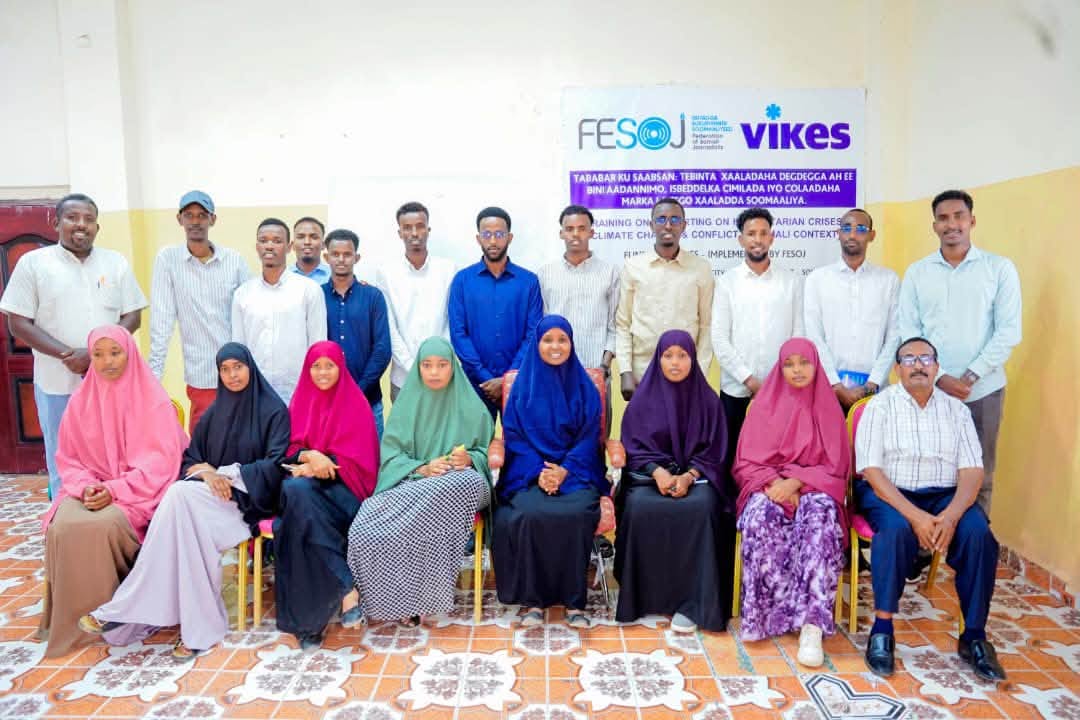
Mogadishu, Somalia – 28 October 2026 –The Federation of Somali Journalists (FESOJ), with support from the Finnish Foundation for Media and Development (VIKES), has successfully completed a two-day training on reporting on humanitarian crises, climate change and conflict in Somali context in Beledweyne city, Hirshabelle State Mogadishu, Somalia. The training held on 25th to 26th October 2026 was aimed at strengthening their capacity to report accurately and effectively on humanitarian crises, climate change and conflict in the Somali context.
The training brought together twenty participants from various sectors, including journalists, representatives from the Hiran regional administration, the Hirshabelle Ministry of Environment and Climate Change, and organizations working on environmental issues.
Speaking at the opening session, Abdiwaajid Sheikh Nuuriyow , Chairperson for Social Affairs of the Hiiraan Region noted that the training comes at a time when there are concerns about potential flooding in the Hiiraan region caused by the Shabelle River—flooding linked to weather conditions described as a “Super El Niño.” The Chairperson specifically thanked the Federation of Somali Journalists (FESOJ) and Vikes for their role in organizing and facilitating this training, describing it as a life-saving initiative.
For his part, Ahmed Ali Sharif, the Training Secretary of FESOJ, urged the journalists and all participants to make the most of this training, highlighting its importance in enhancing knowledge and skills for reporting on humanitarian emergencies, climate change, and conflicts.
Additionally, Abdirashid Mohamed Saney, representing the office of the Ministry of Environment and Climate Change coordinator for the Hiiraan region, stated that there is a need to raise public awareness about the problems resulting from climate change—the impacts of which have been felt significantly in Somalia. He noted that climate change is a global problem, yet countries and communities differ in how they manage the risks arising from it. He also expressed his appreciation to FESOJ and Vikes for their efforts in organizing this training.
The main topics covered during the two-day training program included the definition and nature of humanitarian crises and their effects on communities; key principles of humanitarian reporting; the role of the media in humanitarian crises; and the production and presentation of radio programs on humanitarian crises.
Other key themes covered during the training included climate change reporting; the definition and causes of climate change; the links between climate change, clan conflicts, internal displacement and Al-Shabaab movements; the impacts of climate change; reporting on climate solutions; and basic radio climate-story formulas.
Furthermore, the training covered key topics related to conflict, including the different types of conflicts, the root causes of conflicts in Somalia, and their impacts on communities. Participants also explored the positive role of the media in addressing and mitigating conflicts in Somalia, as well as the production of conflict-sensitive radio stories.
Ms. Hawa Luul, a reporter at Radio Berlula in Beledweyne, said: “The training has enhanced our knowledge and skills in climate change reporting. Beledweyne frequently experiences flooding and droughts, and our community will benefit from what we have learned. The training came at the right time, as the rainy season increases the risk of flooding. We are now better equipped to report on climate-related risks and their impact on our community.”
Closing the training, Abdirashid Mohamed Sanay, a representative of the Ministry of Environment and Climate Change, commended FESOJ and VIKES for organizing the training, emphasizing that journalists play a crucial role in reporting on climate change and humanitarian crises affecting Beledweyne and Hirshabelle. He reaffirmed the Ministry’s commitment to sharing environmental and climate-related information with journalists to promote accurate and timely reporting.
The training is part of program activities supported by the Finnish Foundation for Media and Development (VIKES) and implemented by the Federation of Somali Journalists (FESOJ).


