
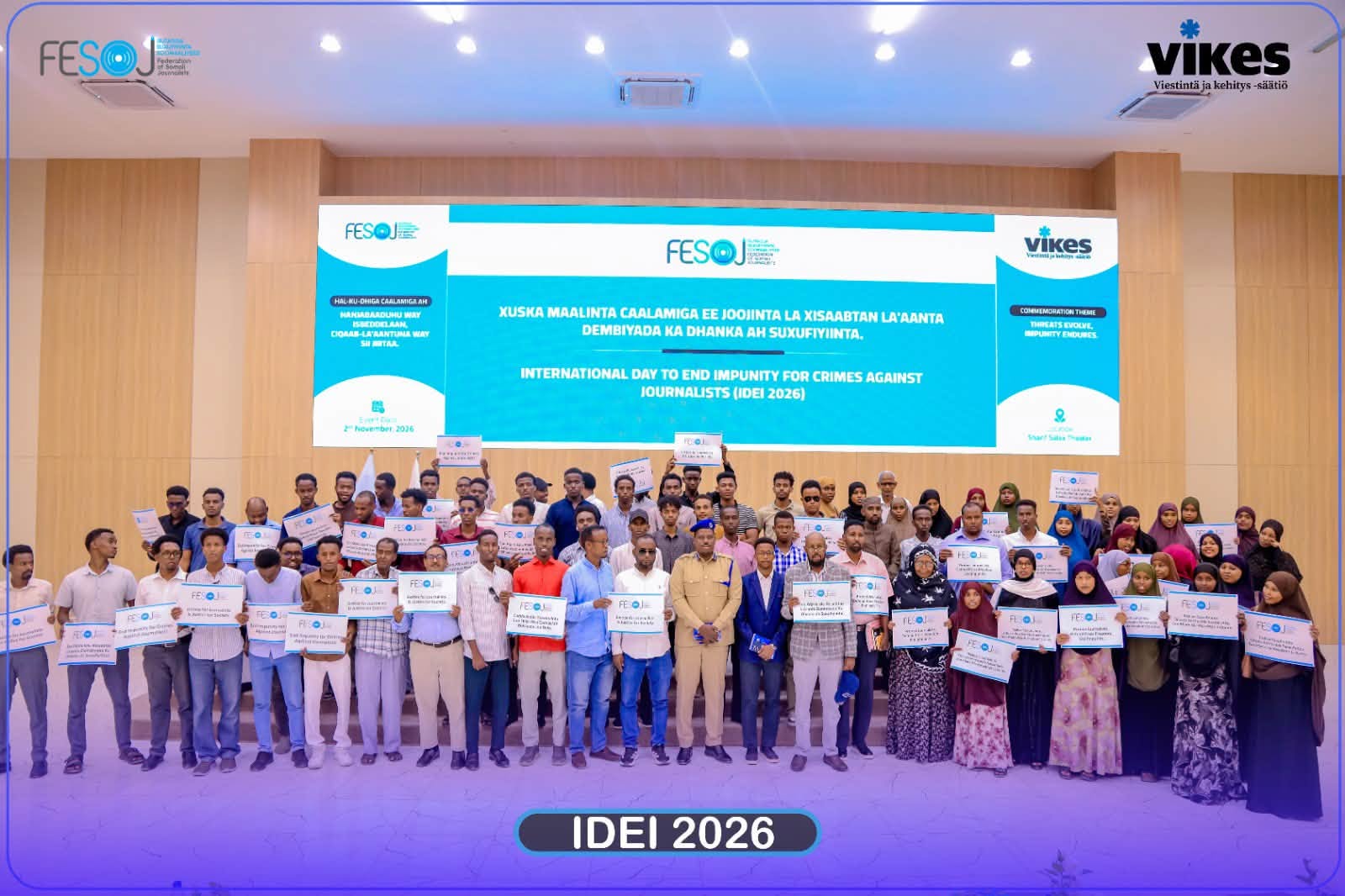
Mogadishu, Somalia, November 2, 2026: With the support of the Finnish Foundation for Media and Development (VIKES), the Federation of Somali Journalists (FESOJ) successfully commemorated the 2026 International Day to End Impunity for Crimes Against Journalists (IDEI) on November 2, 2026, at Sharif Salah Hall, Somali National University, Mogadishu.
The event highlighted the theme “Threats Evolve, Impunity Endures,” emphasizing the urgent need to strengthen journalists’ safety and protection, promote accountability, and end impunity for crimes committed against journalists.
In his opening and welcoming remarks, Mr. Farah Omar Nur, Secretary General of FESOJ, stated today’s commemoration is intended to spark discussion and remind everyone that the abuses committed against journalists must come to an end. “It is a global day dedicated to putting an end to those unchecked abuses.” He further mentioned as FESOJ, our aim this year is to raise awareness about the need to address the challenges faced by Somali journalists. “In particular, today we are conducting panel discussion on how to put an end to all the abuses that occur without any follow-up.”
He pointed out that an assessment of violations in Mogadishu and other regions had revealed that approximately 25 journalists had experienced various forms of abuse. He emphasized the need for collaborative efforts among relevant stakeholders to prevent violations, strengthen journalists’ protection, and promote accountability for crimes committed against media professionals.
Mr. Ahmed Ali Mohamed, Head of FESOJ’s Training Department, presented on the theme “End Impunity, Ensure Justice, and Protect Journalists in Somalia.” He explained that impunity occurs when crimes against journalists are not properly investigated and perpetrators are not held accountable. He highlighted that impunity encourages further attacks, increases threats against journalists, undermines press freedom, and restricts public access to information.
Mr. Ahmed highlighted FESOJ’s efforts to promote equal protection, accessible reporting, and effective complaint mechanisms for journalists with disabilities. He emphasized stronger coordination among media organizations, authorities, legal aid providers, and disability-rights groups to improve journalists’ safety. He concluded that “Ending impunity requires accessible justice, effective protection, and accountability for every attack.”
Mr. Abdullahi Hayir Duale, Director General of the Ministry of Information, Culture and Tourism, commended FESOJ for organizing IDEI 2026. “As we know, our country has laws and a Constitution. Article 17 of the Constitution guarantees freedom of speech and expression, as well as freedom of writing and artistic expression. Furthermore, Press Law No. 26 establishes the independence of the Somali press,” he stated.
He reaffirmed the Ministry’s commitment to constitutional and legal protections for press freedom and supporting Somali journalists nationwide. He also praised FESOJ’s efforts to promote the inclusion and protection of journalists with disabilities.
Mr. Mohamed Abdul Jama, Chairman of the National Disability Association (NDA), called for sustained efforts to support persons with disabilities, particularly journalists. He highlighted the disability rights bill signed into law on December 2, 2024, which provides legal protection and promotes inclusion across all sectors of society. He urged all Somalis to support the rights, dignity, and inclusion of persons with disabilities.
The event’s centerpiece was a panel discussion moderated by veteran journalist Mohamed Mohamud Adde, featuring Major Abdifatah Aden, Somali Police Spokesperson; Ms. Duniya Mohamed Ali, Executive Director of the Women Education Centre (WEC); lawyer Yahye Mohamed Abukar of Hiil Law Firm; and Abdifatah Hassan Ahmed Kalgacal, senior journalist, Chairman of the Somali Disabled Journalists Association (SODJA).
The key points discussed by the panel centered on: Impact of Crimes Against Journalists, Civil Society’s Role in Journalist Protection, Barriers to Justice, Legal Assistance and Police Responsibilities, Rights of Detained Journalists and the Safety Challenges for Journalists with Disabilities:
In conclusion, the panel emphasized that journalists’ safety is a shared responsibility requiring coordinated efforts by the government, security agencies, the judiciary, civil society, and media organizations. Journalists with disabilities have the same rights as other journalists, including equal opportunities, adequate protection, and access to a safe, inclusive, and accessible working environment.
The observation of the IDEI 2026 with special focus on the journalists with disabilities is part of program activities supported by the Finnish Foundation for Media and Development (VIKES) and implemented by the Federation of Somali Journalists (FESOJ).


