

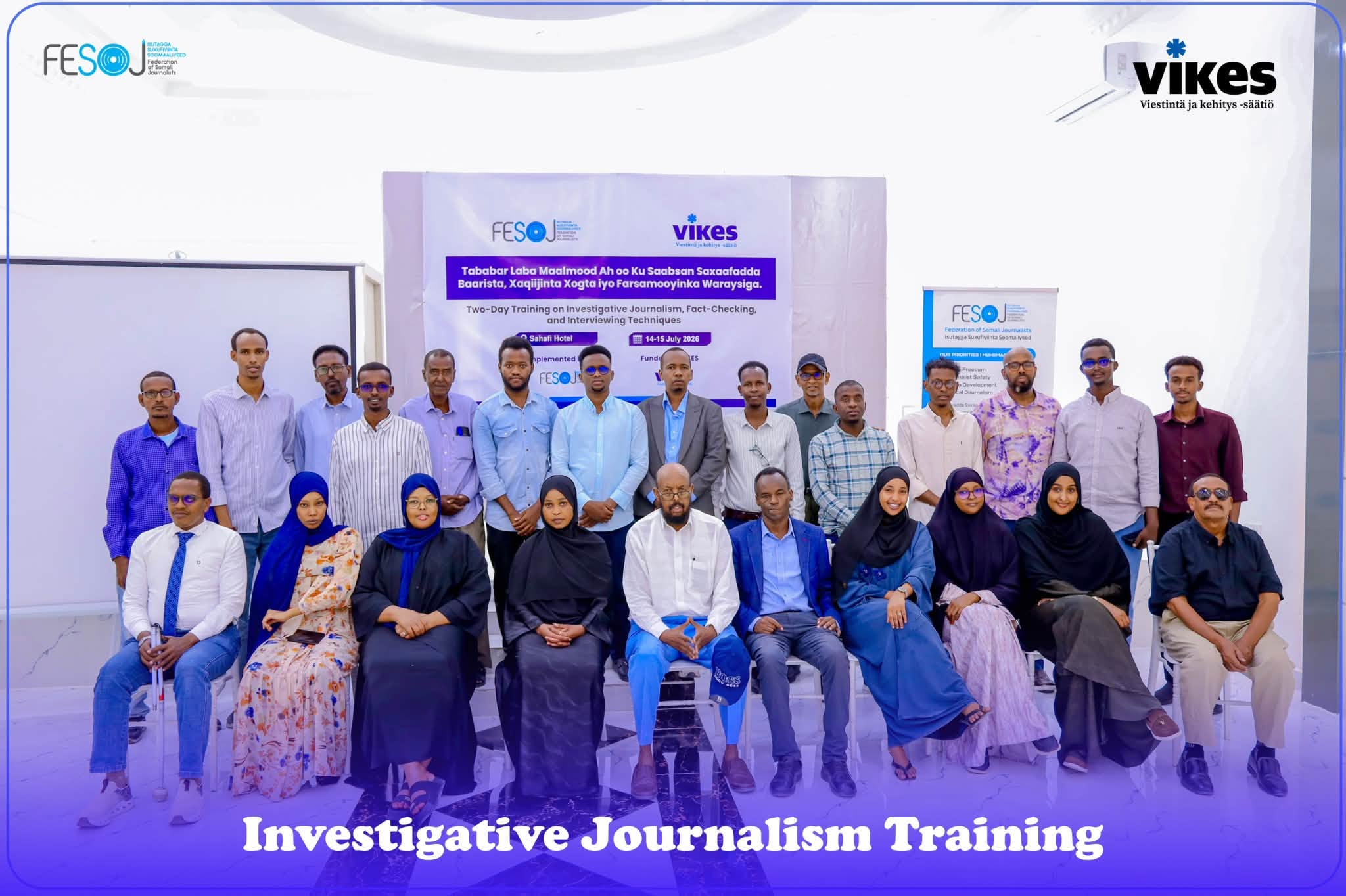
Mogadishu, Somalia – 18 July 2026 – The Federation of Somali Journalists (FESOJ), with support from the Finnish Foundation for Media and Development (VIKES), has successfully concluded a two-day training on Investigative Journalism, Fact-Checking, and Interviewing Techniques in Mogadishu. Held on 14–15 July 2026, the training strengthened journalists’ practical skills in investigative reporting, information verification, and interviewing to enhance the quality, accuracy, and credibility of journalism in Somalia.
The training brought together 20 journalists from Qodob News, Al Arabi Aljadid, Aqal Media House, Asal TV, Radio Arlaadii, RTN TV, Hiran Weyn, Bilan Media, Shabelle TV, Radio Ergo, Somali National University (SNU), SODJA Disability, FESOJ, and freelance journalists. Participants enhanced their capacity to investigate public interest issues, verify information, counter misinformation and disinformation, and uphold ethical journalism standards.
Opening the training, FESOJ Secretary General Farah Omar Nur said the initiative reflects FESOJ’s continued commitment to strengthening professional journalism in Somalia. He encouraged participants to apply the knowledge and practical skills gained to produce accurate, ethical, and impactful reporting in the public interest.
The training was facilitated by Ahmed Ali Mohamed Sharif, Head of FESOJ’s Training Department, with technical contributions from Mohamed Mohamud Adde, Senior Media Expert and FESOJ Consultant, and Wali Hashi, VIKES Somalia Programme Coordinator. The sessions combined theory and practical learning, covering investigative reporting, source development, evidence collection and verification, investigative planning, interviewing techniques, fact-checking, and the distinction between investigative and documentary journalism.
Participants also completed practical group exercises using an investigative planning template to develop story ideas on issues of public interest, including the alleged embezzlement of Sinia land deal funds, illicit drug use, and abuses affecting temporary workers. The exercises strengthened their ability to produce accurate, evidence based, and ethical investigative reporting.
Reflecting on the training, Shukri Aabi Abdi of Shabelle TV said the programme strengthened her investigative journalism, fact-checking, and interviewing skills. Abdulkadir Mohamed Nor Warcade, Chief Editor of Radio Arlaadii in Baidoa, said the training enhanced his capacity to produce evidence based investigative reporting and called for similar opportunities to be extended to journalists across Somalia.
Closing the training, Farah Omar Nur commended the commitment of the 20 participants, including six women and fourteen men, who formed the first cohort of this specialized programme. Certificates were awarded upon successful completion, and participants were encouraged to continue exchanging knowledge through a dedicated FESOJ WhatsApp platform.
The training forms part of FESOJ’s media development programme implemented with the support of the Finnish Foundation for Media and Development (VIKES) to strengthen professional journalism and promote a more credible, ethical, and resilient media sector in Somalia.


